WE'VE MOVED!


As part of our big, new redesign of the Alliance for Justice website, the Justice Watch blog has moved. To be sure you're getting all the latest news about the fight for a fairer America, visit us at www.afj.org/blog
Showing posts sorted by date for query shell. Sort by relevance Show all posts

Tuesday, February 19, 2013

Will cruise passengers be victimized again – by forced arbitration


As they suffered in sweltering heat, walked through sewage and defecated in plastic bags, some of the passengers aboard the Carnival Cruise Lines ship Triumph probably were thinking “At least when we finally get home we can sue the b-----ds.”

The Carnival Triumph in happier times
(including working toilets)
Well, they can try – and some already have.  But the U.S. Supreme Court has made it a lot harder than it should be. 

It appears that Carnival is far better prepared to prevent lawsuits than it was to contain the damage aboard the Triumph.  In the fine print that comes with every ticket, there is a clause that bars most lawsuits.  Instead, passengers must go into forced arbitration.  In addition, when passengers buy a ticket for a Carnival Cruise they give up their right to be part of a class-action suit – though again, one law firm is going to try anyway.

As we explained in a previous post to this blog, and in our 2011 report, Arbitration Activism, this means the deck is stacked against the passengers at every turn.  And in keeping with its role as “The 1% Court” the Supreme Court majority has upheld forced arbitration, and the ban on class actions, in one outrageous case after another.

The Carnival Cruise fine print makes exceptions for individual suits in cases of “personal injury, illness or death.”  In one of the suits brought so far, a passenger cites severe dehydration and bruises suffered while on “aggressive food lines.”    

But passengers whose suffering extended only to enduring heat, stench, limited food and no toilets may be out of luck.  As for the validity of any class action, presumably Carnival could appeal all the way to the Supreme Court – and we know what that is likely to mean.

IT’S EVEN WORSE FOR THE CREW

There is another group that endured worse suffering than the passengers.  As Josh Eidelson points out in Salon, even when nothing goes wrong, conditions on cruise ships can be hell for the crew.  And there is almost nothing they can do about it.

Citing the work of Prof. Ross Klein, the author of Paradise Lost at Sea: Rethinking Cruise Vacations, Eidelson writes: 
Carnival is technically registered in Panama, a country whose laws Klein charges “have been changed to satisfy Carnival’s needs and interests. Because Carnival means a fair amount of money to their national treasury.” Effectively, for cruise workers, says Klein, “there aren’t any real labor regulations.” (He noted that one lawsuit that was brought against Carnival in the U.S. ended with a settlement requiring future such disputes be pursued through an arbitration system, effectively requiring potential worker plaintiffs to shell out tens of thousands of dollars in transportation and legal fees.)[Emphasis added.]

Friday, October 5, 2012

Supreme Court hears oral arguments in Kiobel case

The U.S. Supreme Court heard oral arguments this past Monday, October 1, in Kiobel v. Royal Dutch Petroleum Co. The case presents two major questions. First, whether, under the Alien Tort Statute (ATS), federal courts can hold corporations liable for human rights claims by  non-American plaintiffs for acts that violate the law of nations or treaties. Second, whether foreign plaintiffs can bring actions against foreign defendants under the ATS for harms occurring outside of the United Sates. This is the second time the Roberts Court has heard oral arguments in Kiobel; after the first hearing in February, the Court asked the parties to address the additional second question. The Court heard oral argument on this new issue on Monday.

Paul L. Hoffman, representing the plaintiffs, argued that ATS grants federal courts jurisdiction in just this type of case, where aliens have been harmed by a party in violation of international norms and U.S. treaties. The history of ATS and the Supreme Court’s precedent in Sosa v. Alvarez-Machain support extending jurisdiction when the incident in question occurs in foreign territory. Congress enacted the ATS as part of the Judiciary Act of 1789 with enforcement of certain norms, or the law of nations, in mind, Hoffman explained. Piracy and attacks on ambassadors, for example, were considered universally recognized norms, and Congress’ enactment of the ATS gave federal courts the means to enforce these kinds of norms. By extension, the plaintiffs’ allegations fit within the scope of the Alien Tort Statute.

When pressed about the implications of American courts hearing cases where all parties are aliens and the events in question occur outside of the U.S., Hoffman answered that the applicable rules of civil procedure and common law will fairly exclude many cases. For instance, when Justice Alito asked about whether jurisdiction should be granted if hearing the case in a U.S. court would have a damaging effect on foreign policy, Hoffman answered that this question should be handled by the deciding court under the political question doctrine. Another common law rule would consider whether the plaintiff has exhausted other forums, making ATS function as a sort of last resort, or as Justice Sotomayor called it, a “forum by necessity.” Regardless, Congress granted U.S. courts jurisdiction over an extraterritorial incident when it passed ATS, argued Hoffman. 

The federal government, through Solicitor General Donald B. Verrilli, also participated in the oral argument on Monday. Verrilli stated the government must balance competing interests such as foreign relations, allowing U.S. companies to be subject to foreign jurisdictions, and upholding international human rights. In light of that, General Verrilli argued, when a case does not have a substantial connection to the U.S., there should be no jurisdiction. This approach would considerably narrow the ATS, and bar the Kiobel suit, but would not be as restrictive as Shell’s position.

Alliance for Justice has closely followed the Kiobel litigation, recently following guest posts by Yale Law’s Oona Hathaway and Harvard Law’s Tyler Giannini and Susan Farbstein. Additional coverage of Kiobel appears in Slate, the New York Times, USA Today, SCOTUSblog, and The Christian Science Monitor. Many of these authors, along with human rights and international law advocates, urge the Supreme Court to reaffirm America’s commitment to human rights leadership by siding with Esther Kiobel, rather than giving impunity to corporate defendants who commit abuses across the globe.

Saturday, September 29, 2012

Supreme Court to Hear Major Human Rights Case Again: Much More at Stake the Second Time Around


Guest Post by Tyler Giannini & Susan Farbstein

Susan Farbstein & Tyler Giannini
The Supreme Court will open its new term on Monday.  The first argument it hears will be Kiobel v. Royal Dutch Petroleum Co., the most significant human rights case to reach the Court in recent years.  Intense interest in the case has generated more than 80 amicus curiae briefs from a range of actors around the world, including governments, human rights organizations, and corporations.  Kiobel is especially intriguing not only because of the human rights issues at stake, but also because it will be the Court’s second time hearing oral argument in the matter.  This is a rarity; the last example was Citizen United, the major campaign finance case.

What are the issues?

Kiobel is an Alien Tort Statute (“ATS”) suit based on a 1789 statute that allows non-U.S. citizens to bring civil claims in U.S. federal courts for universally recognized violations of international law.  The case arises out of allegations that Royal Dutch/Shell was complicit in killings and other abuses by the Nigerian government in the 1990s.  The Court first heard Kiobel last February, addressing the question of whether corporations can be held liable under the statute.  But in an unusual move, a week later the Court requested supplemental briefing and a second oral argument.  

At the first oral argument in February, it quickly became clear that some of the justices were interested in additional questions beyond corporate liability.  Specifically, they asked about whether the ATS permits claims that arise out of actions that take place on foreign soil (in this case, Nigeria).  This question—whether, and when, the ATS allows such suits—was the focus of the supplemental briefing and will be addressed in the second oral argument. 

As the Petitioners and their amici have explained, the text of the statute, as well as its history, show that the ATS does allow for cases arising on foreign soil.  It was intended to provide a remedy for universal violations, including piracy, which by definition occur outside the United States.  For example, one of the earliest interpretations of the ATS, by Attorney General William Bradford in 1795, involved pillage and plunder committed during a raid on the British colony of Sierra Leone.

What is at stake?

On the question of corporate liability, Shell’s lawyers have advocated for a categorical rule: there should be no corporate liability under the statute under any circumstances.  Shell’s lawyers are proposing a similarly absolutist rule on the question of extraterritoriality: plaintiffs should never be allowed to bring ATS claims for violations occurring outside the United States.  This view is in opposition to the U.S. government’s position, and has drawn the attention of numerous commentators, including John Ruggie, the former UN Special Representative on business and human rights, who views Shell’s position as “extraordinarily far-reaching.”

Shell’s views raise the stakes of the case.  Its stance on corporate liability departs from more than fifteen years of corporate ATS jurisprudence.  But Shell’s proposed rule on extraterritoriality would be an even more profound reversal, departing from more than thirty years of ATS case law. 

The first seminal ATS case—Filártiga, considered the Brown v. Board of international human rights litigation in U.S. courts—launched the modern era of ATS jurisprudence in 1980.  Dolly Filártiga brought her case in New York against the Paraguayan police official who had tortured her brother to death.  The court’s decision was rooted in the notion that today’s torturers, like eighteenth century pirates, are the enemies of all mankind.  Filártiga was endorsed by the Supreme Court in its 2004 ATS decision, Sosa v. Alaverez-Machain. 

The categorical rule now advanced by Shell would close the door to remedies for plaintiffs like Dolly Filártiga, who wrote before Sosa: “I am proud to live in a country where human rights are respected, where there is a way to bring to justice people who have committed horrible atrocities.  Now it is up to the Supreme Court to ensure that truth will continue to triumph over terror.”  Her sentiments remain as moving today as they did then.

What might happen?

As with so many cases, it is difficult to make predictions, but most commentators are focused on Justice Anthony Kennedy as the critical swing vote.  Justice Kennedy has been a supporter of international law and joined the majority in Sosa, which allowed ATS claims to proceed in narrow circumstances for well-recognized violations of international law.  At the same time, Justice Kennedy and the Court have been notably sympathetic to corporate interests in recent years.  After Monday, we may have a better sense of what to expect in Kiobel. 

The Sosa Court left the door ajar to ATS suits for universal violations, whether piracy or genocide, whether committed outside the United States or within its borders.  This Court should do the same.  Survivors of torture, extrajudicial killing, crimes against humanity, and war crimes deserve the opportunity to obtain justice in U.S. courts, just as Dolly Filártiga did more than thirty years ago.   

Tyler Giannini and Susan Farbstein are the co-directors of the International Human Rights Clinic at Harvard Law School.  They are currently co-counsel in two Alien Tort Statute cases and have submitted amicus curiae briefs in numerous others, including in support of the Petitioners in Kiobel v. Royal Dutch Petroleum Co.  Giannini served as one of the architects of Doe v. Unocal, a precedent-setting suit that settled in 2005.  Farbstein was a member of the legal team in Wiwa v. Royal Dutch Petroleum Co., the companion case to Kiobel that settled in 2009.   

Friday, September 28, 2012

What's really at stake in Kiobel v. Royal Dutch Shell


When the U.S. Supreme Court starts its 2012-2013 term on Monday the very first case it is scheduled to hear involves a law passed by the first U.S. Congress in 1789.  At that time, the Congress allowed aliens victimized by a violation of international law to seek civil redress in U.S. courts.  In this post, Professor Oona Hathaway of Yale Law School argues that “No Congress in the more than 200 years since has revisited this decision.  The Supreme Court should not do so now in a misguided attempt to correct problems with the law that do not, in truth, exist.”


Guest Post by Professor Oona Hathaway
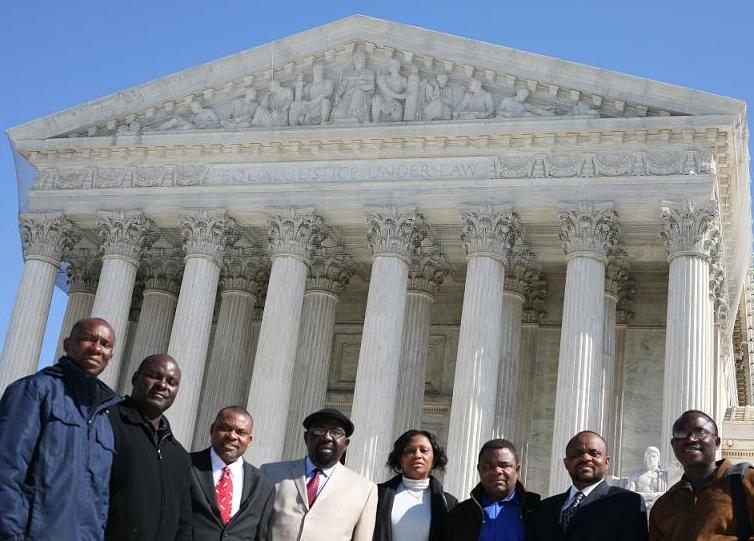
Kiobel plaintiffs on
February 28, 2012.
Photo via
Amnesty International USA

On the face of it, the re-argument of Kiobel v. Royal Dutch Shell is about whether the Alien Tort Statute (ATS) applies to conduct that occurs outside the geographic borders of the United States.  But behind this surface issue are two deeper concerns that are really motivating the debate—concerns that, when examined closely, turn out to be misplaced.

The first is a worry that the U.S. courts will become the courts of the world.  The U.S. is alone, the argument goes, in allowing individuals harmed by human rights abuses to sue those responsible.  Moreover, the ATS allows aliens to sue defendants that have no connection to the United States for conduct that happened outside the United States.  Clearly, then, allowing this case to proceed will open the floodgates!

Nothing could be further from the truth.  The U.S. is one of many countries—including the Netherlands, the home of Royal Dutch Shell—that provides for the enforcement of international human rights law in its courts.  Indeed, in preparing our supplemental amicus brief for re-argument, the Yale Law School Center for Global Legal Challenges gathered a large number of foreign cases, statutes, and constitutions that expressly provide for such enforcement.  The United States is in good company.

Moreover, there are a variety of doctrines that already exist to keep cases out of U.S. courts if they belong elsewhere. These include personal jurisdiction, forum non conveniens, act of state doctrine, and exhaustion.  Indeed, under personal jurisdiction doctrine, foreign defendants are subject to suit in U.S. courts only if they have sufficient contacts with the United States.  Royal Dutch Shell, which does extensive business in the United States, so clearly meets this test (as the ubiquitous Shell gas stations attest) that it did not even raise the issue below.

A second, and related, concern motivating the debate is a worry that the United States is improperly imposing U.S. law abroad.  The background presumption against extraterritorial application of U.S. law can be understood as an effort to respect the sovereignty of other states:  Foreign states should have the freedom to regulate behavior within their own geographic boundaries, hence U.S. courts should not apply U.S. law to conduct abroad unless Congress expressly so provides.  That is because doing so risks imposing distinctive U.S. law to conduct that is more appropriately regulated by the state in which the conduct occurs.

Yet this does not apply in this case or any other ATS case.  The plaintiffs are not asking the Supreme Court to apply distinctive U.S. law to conduct that occurred abroad.  They are asking U.S. courts to enforce international law—including the prohibition on torture, crimes against humanity, and extrajudicial killing—that the country in which the conduct occurred has itself accepted (if not always honored).
 
The ATS does not supply substantive rules that govern conduct abroad.  Instead it simply provides for the enforcement of existing international law norms.  International law makes clear that each state has the sovereign prerogative to do just this—to determine when and how to enforce international law. Indeed, a foundational principle of international law known as the Lotus principle provides that, in the absence of a specific prohibitive rule, “every State remains free to adopt the principles which it regards as best and most suitable.”

In 1789, the First U.S. Congress decided to allow aliens victimized by a violation of international law to seek civil redress in U.S. courts.  No Congress in the more than 200 years since has revisited this decision.  The Supreme Court should not do so now in a misguided attempt to correct problems with the law that do not, in truth, exist.


Oona A. Hathaway is the Gerard C. and Bernice Latrobe Smith Professor of International Law at Yale Law School. Professor Hathaway is the director of the Yale Law School Center for Global Legal Challenges, which filed amicus briefs on behalf of Esther Kiobel in this case. She is currently a committee member on the Advisory Committee on International Law for the Legal Advisor at the State Department. Professor Hathaway has also served as a law clerk for Justice Sandra Day O’Connor and lectured at Harvard Law School, UC Berkeley School of Law, and Boston University School of Law.  

Thursday, June 14, 2012

One Year Later: The Consequences of Janus Capital v. First Derivative Traders

In Janus Capital Group, Inc. v. First Derivative Traders, Inc., a case decided one year ago this month, the Supreme Court hampered the Securities and Exchange Commission (SEC) in its efforts to combat fraud, by deciding that white-collar criminals could devise complex structures of shell corporations to avoid accountability. The decision – part of a growing trend of corporation-friendly 5-4 rulings engineered by the conservative wing of the Court – was ostensibly intended to create a bright-line rule that would clarify the application of important corporate accountability regulations, but has instead confused and divided lower courts and stifled the effectiveness of those checks on corporate practices. This confusion makes it more likely that the issue decided in Janus could end up back before the Supreme Court one day soon. In the meantime, Congress or the SEC can act to repair the damage done to corporate accountability mechanisms by Janus.

According to its drafters, the story behind SEC Rule 10b-5 began with an anecdote that circulated around SEC offices in 1942. A wealthy Boston banker had made a fortune by fleecing his investors, telling them (falsely) that the bank was in dire trouble, purchasing their stock at a sharp discount, and reaping huge profits when, in fact, the bank’s stock quadrupled in value soon thereafter. At the time, the SEC had adopted rules penalizing fraud related to the sale of securities, but no rule existed to penalize securities purchasers who engaged in fraud. Rule 10b-5 changed that, authorizing the SEC, as well as the affected stockholders, to sue buyers or sellers who engaged in securities fraud. Since its adoption, Rule 10b-5 has been described as “the primary vehicle for class actions against public companies based upon allegations of false disclosure and the legal source for the prohibition of insider trading.” The Janus ruling, however, has brought the continued vitality of Rule 10b-5 into question.

Wednesday, February 22, 2012

No Corporate Exemption: Supreme Court to Hear Major Corporate Human Rights Case

Guest post by Tyler Giannini & Susan Farbstein

Next Tuesday, the Supreme Court will hear oral arguments in Kiobel v. Royal Dutch Petroleum Co.  Kiobel is the most important human rights case the Court will consider this term, raising fundamental questions about corporate accountability.  The Plaintiffs allege that Royal Dutch/Shell was complicit in the Nigerian government’s torture and killing of their relatives in the 1990s.  The Supreme Court is reviewing a lower court decision that created a corporate exemption from liability under the Alien Tort Statute (“ATS”), concluding that corporations cannot be sued even when they facilitate genocide, crimes against humanity, or war crimes.

The ATS, a 1789 law passed by the First Congress, permits non-U.S. citizens to hold perpetrators accountable in U.S. courts for violations of international law.  In the fall of 2010, however, the Second Circuit Court of Appeals in New York created the corporate exemption now under review.  Since the Second Circuit’s decision, every other appellate court to consider the issue has rejected Kiobel’s approach.  Recognizing the importance of this question and the split among the lower courts, the Supreme Court agreed to hear the case.

Yesterday, the Plaintiffs filed their final brief before the oral argument.  They noted the profound ramifications of the lower court’s holding:
The implications of the decision below are shocking.  When I.G. Farben exploited slave labor at Auschwitz and supplied the Zyklon B poison to facilitate mass murder in its death chambers, that corporation violated international law.  [Defendants’] construction of the ATS means that even a modern-day I.G. Farben could not be sued under the ATS.  Nor could a “Pirates, Inc.” engaged in contemporary piracy, or an entity incorporated to engage in slavery.
Given the significance of blanket immunity for corporate human right abuse, it is no surprise that the U.S. government has weighed in with an amicus curiae brief in support of the Plaintiffs.  The U.S. government noted that corporations are certainly capable of violating international law, and found “no good reason to conclude that the First Congress would have wanted the suit to proceed only against the potentially judgment-proof individual actor, and to bar recovery against the company on whose behalf he was acting.”  The government’s brief further observed that “[c]orporations have been subject to suit for centuries, and the concept of corporate liability is a well-settled part of our ‘legal culture.’”

For fifteen years before Kiobel, the statute enabled survivors of corporate human rights abuse to pursue accountability here, when it was otherwise unavailable.  For example, Plaintiffs sought redress for corporate complicity in forced labor in Burma, apartheid in South Africa, and extrajudicial killings in Nigeria.  While only cases against companies involved in such egregious human rights violations moved forward, no court contemplated a corporate shield from liability.  With Kiobel, the Supreme Court has an opportunity to reaffirm the U.S. commitment to provide justice to survivors of egregious human rights abuse.  Relief from suffering should not depend on whether an individual or a corporation is responsible for the violation.

---

Tyler Giannini and Susan Farbstein teach at Harvard Law School, and are the Clinical Director and Associate Clinical Director of its Human Rights Program. They are currently co-counsel in two Alien Tort Statute cases and have submitted amicus curiae briefs in numerous others, including in support of the Petitioners in Kiobel v. Royal Dutch Petroleum Co.  Giannini served as one of the architects of Doe v. Unocal Corp., a precedent-setting corporate ATS suit that settled in 2005.  Farbstein was a member of the legal team in Wiwa v. Royal Dutch Petroleum Co., the companion case to Kiobel that settled in 2009.

Monday, April 18, 2011

Supreme Court Set to Hear Oral Arguments in Global Warming Case

The Supreme Court will hear oral arguments tomorrow in American Electric Power v. Connecticut. At stake is the ability of citizens to stop corporate polluters from emitting harmful greenhouse gases. The Court must decide whether states and private parties can sue utility companies to cap global warming emissions. Eight states (now six after the Republican governors of New Jersey and Wisconsin withdrew), the City of New York, and three private land trusts allege that greenhouse gas emissions that cause global warming constitute a public nuisance for which polluters should be liable under common law. The defendant utility companies – American Electric Power, Cinergy, Southern Company, Xcel Energy and the Tennessee Valley Authority – are the five largest emitters of carbon dioxide pollution in the United States. The defendants’ combined 650 million tons of annual carbon dioxide pollution constitutes 10 percent of America’s carbon dioxide emissions. The Second Circuit denied a motion to dismiss, allowing the case to move forward. Justice Sonia Sotomayor was on the three-judge panel that initially heard the case but was elevated to the Supreme Court prior to the decision and is recusing herself from the case.

The defendants appeal to the Supreme Court argues that plaintiffs cannot show that global warming is traceable to these defendants, or that it would be alleviated if a court orders them to reduce their carbon emissions; that because the Clean Air Act grants the Environmental Protection Agency (EPA) the authority to regulate carbon emissions, there is no room for a federal common law claim; and that a court is not equipped to evaluate whether defendants emissions are unreasonable.

Most of these arguments are easily rebuttable. For example, it's hard to see how contributors of 10 percent of America's annual emissions of greenhouse gases should not be potentially liable even if there are millions of other contributing sources. Speeders don't get to escape a ticket just because others are driving too fast on the nation's roads. Given the fact these defendants are the five largest carbon dioxide emitters in the United States, a reduction in their greenhouse gas emissions should have some benefit even if it won't solve the overall problem.

The EPA is also hardly covering the field. Although the EPA is currently drafting regulations to regulate greenhouse gases, it took a lawsuit by states—Massachusetts v. EPA—to establish that EPA had this authority. Under the Bush administration, EPA took the position that it had no authority to regulate greenhouse gases. Moreover, the regulations EPA is drafting will not directly affect the defendants’ power plants. EPA's rules will govern mobile sources, like cars and trucks. They will only affect stationary power plants if those plants are new or become modified.

As for whether courts can fashion a remedy to curb the unreasonableness of defendants' emissions, this is something they have done in public nuisance cases as far back as pre-Revolutionary times. The plaintiffs explain that public nuisance claims have been adjudicated in the Anglo-American judicial system since the 14th century. The Supreme Court “has long adjudicated common-law public-nuisance claims brought by States seeking to enjoin air or water pollution that crosses state boundaries, sometimes based on new scientific knowledge about the harm caused by a particular type of pollution.” Thus, once a public nuisance violation has been established, courts have historically been able to craft a remedy. In this case it would not be to solve global warming; it would be to address these defendants level of carbon emissions.

Corporate polluters, including Chevron, Shell Oil, ConocoPhillips, the National Mining Association, and a host of others have filed amicus briefs in support of the defendants. In addition, conservative foundations that have received millions of dollars from Charles and David Koch for climate change denial activities have filed amicus briefs on behalf of the polluters. These include the Cato Institute, which was co-founded by Charles Koch and has received more than $13.6 million from the Koch brothers, and the Washington Legal Foundation, which has received $1.2 million from the Koch brothers.

In an ironic twist, several Republican members of Congress who otherwise have sought to kill global warming regulations and the EPA filed a brief arguing that the Court should block the lawsuit as preempted by EPA's statutory authority to regulate greenhouse gases. One of the brief's signers, Senator James Inhofe, has called global warming “the greatest hoax ever perpetuated on the American people.” Republicans in the House have used budget debates to attempt to prevent the EPA from regulating greenhouse gas emissions and reduce its funding by one-third, more than any other agency.

If the Supreme Court sides with polluters, it will prevent citizens from holding corporations responsible for their contributions to global warming.

Click here for a New York Times editorial urging the Supreme Court to allow the lawsuit to go forward.