Guest post by Thomas D. Rowe, Jr., Elvin R. Latty Professor Emeritus, Duke University School of Law
A spectre is haunting aggregate litigation--the spectre of “pick-off” offers.
To begin close to the beginning: Somewhat incredibly, the law in the Seventh Circuit has long been that a putative class representative who receives but does not accept a full-satisfaction Rule 68 offer of judgment suffers mooting of the action, with the consequence that the case is dismissed for lack of subject-matter jurisdiction and the plaintiff takes nothing.1 To be fair, these were cases in which class certification had been denied; and not all federal courts agree with the Seventh Circuit that the plaintiff with a claim mooted by an unaccepted full-satisfaction offer loses outright.2
Readers not already immersed in the arcana of formal Rule 68 offers of judgment may need a bit of background before I get to the spectre posed by the Supreme Court’s recent decision in Genesis Healthcare Corp. v. Symczyk. Federal Rule of Civil Procedure 68 permits a party defending against a claim to serve “an offer to allow judgment on specified terms, with the costs then accrued.” If the opposing party accepts within 14 days, the court clerk must enter judgment. The kicker (and the incentive for defendants to make formal offers of judgment, not just offer terms in settlement negotiations) is that if the offeree doesn’t accept and obtains a judgment that “is not more favorable than the unaccepted offer, the offeree must pay the costs incurred after the offer was made.”

Showing posts with label guest post. Show all posts
Showing posts with label guest post. Show all posts
Friday, April 19, 2013


Saturday, September 29, 2012
Supreme Court to Hear Major Human Rights Case Again: Much More at Stake the Second Time Around
Guest Post by Tyler
Giannini & Susan Farbstein
 |
| Susan Farbstein & Tyler Giannini |
The Supreme
Court will open its new term on Monday. The
first argument it hears will be Kiobel v.
Royal Dutch Petroleum Co., the most significant human rights case to reach
the Court in recent years. Intense
interest in the case has generated more than 80 amicus curiae briefs from a range of actors around the world,
including governments, human rights organizations, and corporations. Kiobel
is especially intriguing not only because of the human rights issues at stake,
but also because it will be the Court’s second time hearing oral argument in the matter. This is a rarity; the last example was Citizen United, the major campaign
finance case.
What are the
issues?
Kiobel is an Alien Tort Statute (“ATS”) suit
based on a 1789 statute that allows non-U.S. citizens to bring civil claims in
U.S. federal courts for universally recognized violations of international
law. The case arises out of allegations
that Royal Dutch/Shell was complicit in killings and other abuses by the
Nigerian government in the 1990s. The
Court first heard Kiobel last February,
addressing the question of whether
corporations can be held liable under the statute. But in an unusual move, a week later the
Court requested supplemental briefing and a second oral argument.
At the first oral
argument in February, it quickly became clear that some of the justices were
interested in additional questions beyond corporate liability. Specifically, they asked about whether the
ATS permits claims that arise out of actions that take place on foreign soil
(in this case, Nigeria). This question—whether,
and when, the ATS allows such suits—was the focus of the supplemental briefing
and will be addressed in the second oral argument.
As the Petitioners
and their amici have explained, the
text of the statute, as well as its history, show that the ATS does allow for
cases arising on foreign soil. It was
intended to provide a remedy for universal violations, including piracy, which
by definition occur outside the United States.
For example, one of the earliest interpretations of the ATS, by Attorney
General William Bradford in 1795, involved pillage and plunder committed during
a raid on the British colony of Sierra Leone.
What is at
stake?
On the
question of corporate liability, Shell’s lawyers have advocated for a
categorical rule: there should be no corporate liability under the statute
under any circumstances. Shell’s lawyers
are proposing a similarly absolutist rule on the question of
extraterritoriality: plaintiffs should never be allowed to bring ATS claims for
violations occurring outside the United States.
This view is in opposition to the U.S. government’s position, and has
drawn the attention of numerous commentators, including John Ruggie, the former
UN Special Representative on business and human rights, who views Shell’s position
as “extraordinarily
far-reaching.”
Shell’s views
raise the stakes of the case. Its stance
on corporate liability departs from more than fifteen years of corporate ATS
jurisprudence. But Shell’s proposed rule
on extraterritoriality would be an even more profound reversal, departing from more
than thirty years of ATS case law.
The first
seminal ATS case—Filártiga, considered
the Brown v. Board of international
human rights litigation in U.S. courts—launched the modern era of ATS jurisprudence
in 1980. Dolly Filártiga brought her
case in New York against the Paraguayan police official who had tortured her
brother to death. The court’s decision
was rooted in the notion that today’s torturers, like eighteenth century
pirates, are the enemies of all mankind.
Filártiga was endorsed by the
Supreme Court in its 2004 ATS decision, Sosa
v. Alaverez-Machain.
The categorical
rule now advanced by Shell would close the door to remedies for plaintiffs like
Dolly Filártiga, who wrote before Sosa:
“I am proud to live in a country where human rights are respected, where there
is a way to bring to justice people who have committed horrible atrocities. Now it is up to the Supreme Court to ensure
that truth will continue to triumph over terror.” Her sentiments remain as moving today as they
did then.
What might
happen?
As with so
many cases, it is difficult to make predictions, but most commentators are
focused on Justice Anthony Kennedy as the critical swing vote. Justice Kennedy has been a supporter of
international law and joined the majority in Sosa, which allowed ATS claims to proceed in narrow circumstances
for well-recognized violations of international law. At the same time, Justice Kennedy and the
Court have been notably sympathetic to corporate interests in recent
years. After Monday, we may have a
better sense of what to expect in Kiobel.
The Sosa Court left the door ajar to ATS suits
for universal violations, whether piracy or genocide, whether committed outside
the United States or within its borders. This Court should do the same. Survivors of torture, extrajudicial killing,
crimes against humanity, and war crimes deserve the opportunity to obtain
justice in U.S. courts, just as Dolly Filártiga did more than thirty years ago.
Tyler
Giannini and Susan Farbstein are the co-directors of the International Human
Rights Clinic at Harvard Law School. They are currently co-counsel in two Alien
Tort Statute cases and have submitted amicus
curiae briefs in numerous others, including in support of the Petitioners in
Kiobel v. Royal Dutch Petroleum Co. Giannini
served as one of the architects of Doe v. Unocal, a precedent-setting
suit that settled in 2005. Farbstein was a member of the legal team in Wiwa
v. Royal Dutch Petroleum Co., the companion case to Kiobel that
settled in 2009.
Friday, September 28, 2012
What's really at stake in Kiobel v. Royal Dutch Shell
When the U.S. Supreme Court starts its 2012-2013 term on
Monday the very first case it is scheduled to hear involves a law passed by the
first U.S. Congress in 1789. At that time, the Congress
allowed aliens victimized by a violation of international law to seek civil
redress in U.S. courts. In this post, Professor Oona Hathaway of Yale Law
School argues that “No Congress in the more than 200 years since has revisited
this decision. The Supreme Court should not do so now in a misguided
attempt to correct problems with the law that do not, in truth, exist.”
Guest Post by Professor Oona Hathaway
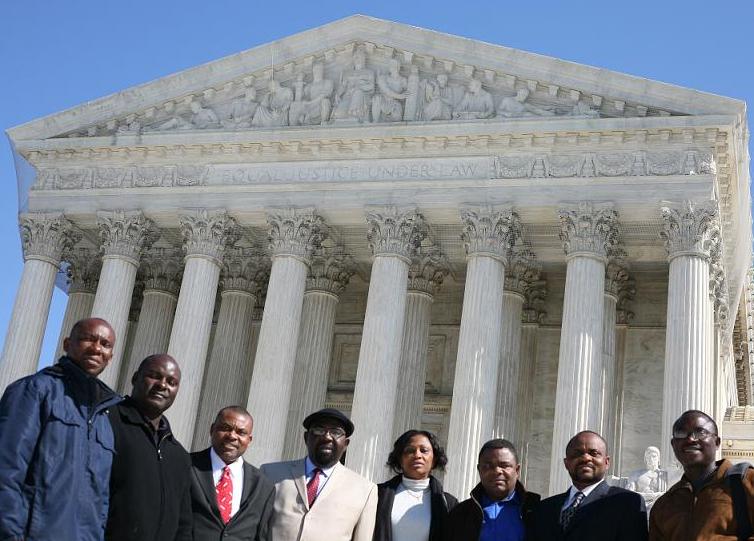 |
| Kiobel plaintiffs on February 28, 2012. Photo via Amnesty International USA |
On the face of it, the re-argument of Kiobel v. Royal Dutch Shell is about whether the Alien Tort Statute (ATS) applies to conduct that occurs outside the geographic borders of the United States. But behind this surface issue are two deeper concerns that are really motivating the debate—concerns that, when examined closely, turn out to be misplaced.
The first is a worry that the U.S. courts will become the courts of the world. The U.S. is alone, the argument goes, in allowing individuals harmed by human rights abuses to sue those responsible. Moreover, the ATS allows aliens to sue defendants that have no connection to the United States for conduct that happened outside the United States. Clearly, then, allowing this case to proceed will open the floodgates!
Nothing could be further from the truth. The U.S. is one of many countries—including the Netherlands, the home of Royal Dutch Shell—that provides for the enforcement of international human rights law in its courts. Indeed, in preparing our supplemental amicus brief for re-argument, the Yale Law School Center for Global Legal Challenges gathered a large number of foreign cases, statutes, and constitutions that expressly provide for such enforcement. The United States is in good company.
Moreover, there are a variety of doctrines that already exist to keep cases out of U.S. courts if they belong elsewhere. These include personal jurisdiction, forum non conveniens, act of state doctrine, and exhaustion. Indeed, under personal jurisdiction doctrine, foreign defendants are subject to suit in U.S. courts only if they have sufficient contacts with the United States. Royal Dutch Shell, which does extensive business in the United States, so clearly meets this test (as the ubiquitous Shell gas stations attest) that it did not even raise the issue below.
A second, and related, concern motivating the debate is a worry that the United States is improperly imposing U.S. law abroad. The background presumption against extraterritorial application of U.S. law can be understood as an effort to respect the sovereignty of other states: Foreign states should have the freedom to regulate behavior within their own geographic boundaries, hence U.S. courts should not apply U.S. law to conduct abroad unless Congress expressly so provides. That is because doing so risks imposing distinctive U.S. law to conduct that is more appropriately regulated by the state in which the conduct occurs.
Yet this does not apply in this case or any other ATS case. The plaintiffs are not asking the Supreme Court to apply distinctive U.S. law to conduct that occurred abroad. They are asking U.S. courts to enforce international law—including the prohibition on torture, crimes against humanity, and extrajudicial killing—that the country in which the conduct occurred has itself accepted (if not always honored).
The ATS does not supply substantive rules that govern conduct abroad. Instead it simply provides for the enforcement of existing international law norms. International law makes clear that each state has the sovereign prerogative to do just this—to determine when and how to enforce international law. Indeed, a foundational principle of international law known as the Lotus principle provides that, in the absence of a specific prohibitive rule, “every State remains free to adopt the principles which it regards as best and most suitable.”
In 1789, the First U.S. Congress decided to allow aliens victimized by a violation of international law to seek civil redress in U.S. courts. No Congress in the more than 200 years since has revisited this decision. The Supreme Court should not do so now in a misguided attempt to correct problems with the law that do not, in truth, exist.

Oona A.
Hathaway is the Gerard C. and Bernice Latrobe Smith Professor of International
Law at Yale Law School. Professor Hathaway is the director of the Yale Law School Center for Global Legal Challenges,
which filed amicus briefs on behalf of Esther Kiobel in this case. She is
currently a committee member on the Advisory Committee on International
Law for the Legal Advisor at the State Department. Professor Hathaway has also served as a law clerk for Justice
Sandra Day O’Connor and lectured at Harvard Law School, UC Berkeley School of
Law, and Boston University School of Law.
Tuesday, January 26, 2010
Ending an Era of Minority-Rule
Guest Post: By Chris Cassidy, Assistant Director of Communications, American Constitution Society for Law and Policy. The views expressed here are solely attributable to Cassidy.
Intra-party struggles, the Bush recession, sharp departures from our commitments to international and domestic law -- none of these developments even competes with the impact of the modern filibuster on American politics.
After winning the White House and amassing super-majorities in both houses of Congress, reforms are creeping through legislative channels at a perilously slow pace. With the bipartisan support of her home state's senators, Dawn Johnsen's nomination remains stalled over a year since being announced. Meanwhile the majority party seems on the verge of panicking over mid-term elections which may leave them with only 54 seats in the Senate.
Yes, 54 seats in the Senate would still be a majority. Yes, 54 seats used to be enough to move nominations and legislation. No, this is not a joke.
These are the very serious consequences of a parliamentary procedure run amok. In the 1950s, filibusters were invoked just once per Congress, on average. In the last Congress, there were 139.
With Republicans feverishly invoking the filibuster at every turn, there has been no shortage of suggestions for how to reform Senate rules to empower legislators to legislate. I do not jump onto the bandwagon calling for reform without hesitation, however. Let's not leave recent Democratic filibusters unacknowledged.
There is something to be said for a system that permits the minority party to moderate judicial nominations. For instance, though used considerably less then, the filibuster proved useful in blocking extremists nominated to the federal bench by President George W. Bush.
But blocking extremists doesn't seem to be the prerogative of today's Republican Senators.
President Obama's nomination of Judge David Hamilton for the Seventh Circuit Court of Appeals was almost universally welcomed as a gesture towards bipartisanship. Hamilton's moderate credentials earned him the support of Republican Senator Richard Lugar as well as the head of the Federalist Society's Indianapolis chapter. With Senator Jeff Sessions leading the way, however, Senate Republicans launched an effort to block Hamilton's nomination, citing one month that he worked with ACORN in 1979 and shamelessly distorting his distinguished judicial record.
The question remains: How do we eliminate knee-jerk filibusters of every legislation and nominee, while preserving the legitimate, counter-majoritarian purpose that the filibuster once served.
A solution may be on the way to the Senate floor as we speak. Sen. Tom Harkin has indicated that, in the coming weeks, he will re-introduce a bill that would change Senate rules to end the minority party's veto power, while preserving their ability to delay Senate action and inform the public debate.
Harkin's bill would permit a filibuster for a fixed period of time until it could be overcome by 57 votes. Should this be insufficient, debate would continue until the time limit is again reached, and cloture could be invoked by 54 senators. Eventually, 51 senators could pass legislation or advance nominations.
Senator Harkin initially proposed the bill in 1995, when he and his fellow Democrats were in the minority. This time, though, he hopes that the devastating gridlock on Capitol Hill will move his fellow senators to action.
While the chances for Harkin's bill remain unclear -- it would require 67 votes to change Senate rules -- the public interest would clearly be best served by bringing an end to the era of minority rule in which we find ourselves. The alternative is that each administration, whether Democrat or Republican, risks becoming a placeholder incapable of legislating or filling judicial and executive vacancies. The American people deserve better, but we will not be extended change without demanding it.
Subscribe to:
Posts (Atom)